
Shri Ramdhari Singh Dinkar Ji
श्री रामधारी सिंह दिनकर जी की पुण्यतिथि पर उनके महान साहित्य, राष्ट्रभक्ति और ओजस्वी काव्य को नमन। जानें उनके जीवन, रचनाओं और प्रेरणादायक योगदान के बारे में।
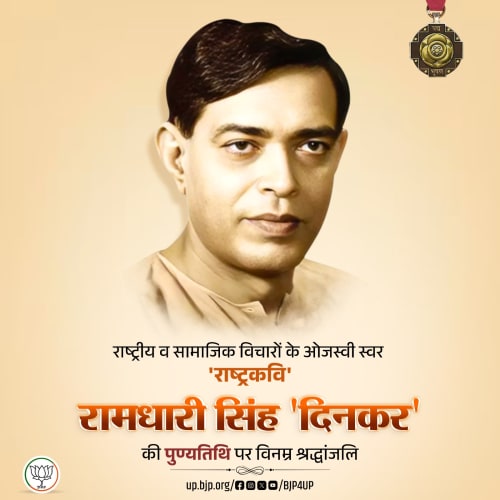
“रश्मिरथी”, “उर्वशी” और “परशुराम की प्रतीक्षा” जैसी कालजयी कृतियों के माध्यम से ‘दिनकर’ जी ने भारतीय संस्कृति, इतिहास और मानवीय संवेदनाओं को अद्भुत स्वर दिया। उनकी लेखनी में वीर रस की गर्जना के साथ-साथ करुणा, प्रेम और नैतिक चेतना का अद्वितीय संतुलन दिखाई देता है।
उन्होंने न केवल स्वतंत्रता संग्राम के समय जन-जन में जोश और स्वाभिमान का संचार किया, बल्कि स्वतंत्र भारत में भी समाज को सही दिशा दिखाने का कार्य किया। उनकी वाणी आज भी अन्याय के विरुद्ध खड़े होने और सत्य के मार्ग पर अडिग रहने की प्रेरणा देती है।
‘दिनकर’ जी का जीवन और साहित्य हमें यह सिखाता है कि विपरीत परिस्थितियों में भी साहस, संघर्ष और आत्मबल के सहारे असंभव को संभव बनाया जा सकता है।
ऐसे महान राष्ट्रकवि को उनकी पुण्यतिथि पर कोटि-कोटि नमन। उनकी अमर वाणी सदैव हमारे विचारों और कर्मों को आलोकित करती रहेगी।”
Dinkar's Legacy in Modern India
Ramdhari Singh Dinkar's legacy is difficult to overstate in the context of Hindi literature and Indian nationalism. He was a poet who understood that language could be a weapon, a rallying cry, and a mirror held up to society simultaneously. His ability to write with the heat of revolutionary poetry while also plumbing the depths of philosophical reflection set him apart from contemporaries who could do one or the other but rarely both.
His epic Kurukshetra, published in 1946, used the framework of the Mahabharata to meditate on the moral questions raised by war and peace — questions that were immediately relevant in the context of India's independence struggle and partition. Urvashi, which won the Jnanpith Award in 1972, explored human desire and the tension between earthly and divine love with a lyrical intensity rarely matched in Hindi poetry.
In classrooms across Bihar, UP, and across the Hindi belt, Dinkar's poems are still recited from memory by students who may not know his biography but carry his rhythms in their blood. That is the measure of a truly great writer — not the shelf of awards but the living presence of their work in the language of ordinary people, decades after their passing.
Ramdhari Singh Dinkar's Literary Legacy
Ramdhari Singh Dinkar (1908–1974) stands as one of the foremost poets of modern Hindi literature. His work combines nationalist fire, philosophical depth, and lyrical beauty. Born in Bihar's Begusarai district, he witnessed colonial India's struggle for independence and translated the rage and aspiration of that era into verse that resonates decades later.
His Most Celebrated Works
- Rashmirathi (1952) — An epic retelling of Karna's story, celebrating the warrior's honour and tragedy. One of Hindi literature's most-read poems.
- Kurukshetra (1946) — A philosophical meditation on war, questioning the morality of violence.
- Urvashi (1961) — A lyrical drama for which he received the Sahitya Akademi Award and, later, the Jnanpith Award.
- Sanskriti ke Char Adhyaya (1956) — A prose examination of Hindu, Buddhist, and Islamic cultural synthesis in India.
Dinkar and the National Consciousness
Dinkar was elected to the Rajya Sabha and honoured with the Padma Bhushan. His most famous line — "Singhaasan khali karo ki janata aati hai" (Vacate the throne, for the people are coming) — became an anthem of the JP Movement in 1974. His voice gave language to a nation's hopes, fears, and moral conscience.
Frequently Asked Questions
What is Shri Ramdhari Singh Dinkar Ji?
श्री रामधारी सिंह दिनकर जी की पुण्यतिथि पर उनके महान साहित्य, राष्ट्रभक्ति और ओजस्वी काव्य को नमन। जानें उनके जीवन, रचनाओं और प्रेरणादायक योगदान के बारे में।
Why is Shri Ramdhari Singh Dinkar Ji important?
खम ठोंक ठेलता है जब नर, पर्वत के जाते पाँव उखड़। मानव जब जोर लगाता है, पत्थर पानी बन जाता है।। राष्ट्रीय चेतना के प्रखर स्वर ‘राष्ट्रकवि’ रामधारी सिंह ‘दिनकर’ की पुण्यतिथि पर विनम्र श्रद्धांजलि। This development is significant because it affects a large number of people and has wide-ranging implications.
What are the key highlights of Shri Ramdhari Singh Dinkar Ji?
श्री रामधारी सिंह दिनकर जी की पुण्यतिथि पर उनके महान साहित्य, राष्ट्रभक्ति और ओजस्वी काव्य को नमन। जानें उनके जीवन, रचनाओं और प्रेरणादायक योगदान के बारे में। For full details, read the complete article above which covers all the major points.
How does Shri Ramdhari Singh Dinkar Ji affect common people?
Shri Ramdhari Singh Dinkar Ji directly impacts the daily lives of millions of Indians by influencing policies, prices, opportunities, or events that concern them. The full impact is discussed in the article with supporting data and expert perspectives.
Where can I find the latest updates on Shri Ramdhari Singh Dinkar Ji?
ApnaInsights regularly publishes the latest news and analysis on Shri Ramdhari Singh Dinkar Ji and related topics. You can bookmark this page and follow us to stay updated with accurate, timely information.
Version History 5 updates
- Jun 16, 2026
Updated: content
- Jun 16, 2026
Updated: faqs
- Jun 5, 2026
Updated: content
- Apr 25, 2026
Updated: title, description, content, categories, tags, featuredImage, status
- Apr 24, 2026
Updated: title, description, content, categories, tags, featuredImage, status