
How AI Is Impacting Todays Job Market: Pros, Cons, Skills to Learn, and How to Prepare
Discover how Artificial Intelligence (AI) is changing the job market. Learn the benefits, challenges, future job opportunities, skills to learn, and how to prepare for an AI-driven future.
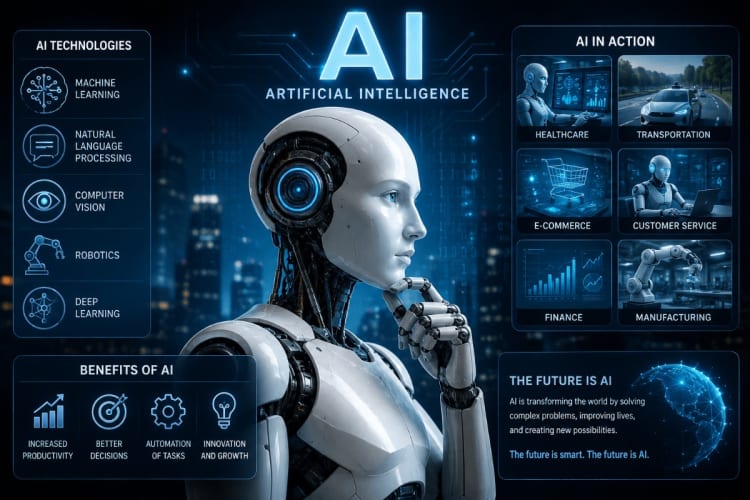
How AI Is Impacting Today's Job Market
Artificial Intelligence (AI) is no longer a future technology. It is already changing the way businesses work, how employees perform tasks, and what skills companies look for when hiring.
From customer support and content writing to software development and healthcare, AI is becoming a part of almost every industry. While AI creates many opportunities, it also brings challenges that workers and businesses must understand.
In this article, we will explore the impact of AI on the current job market, its advantages and disadvantages, the skills people should learn, and how to prepare for the future.
What Is AI?
Artificial Intelligence (AI) refers to computer systems that can perform tasks that normally require human intelligence. These tasks include:
- Understanding language
- Answering questions
- Analyzing data
- Creating content
- Solving problems
- Recognizing images and speech
Popular AI tools such as ChatGPT, Gemini, Copilot, and Midjourney are being used by millions of people worldwide.
How AI Is Changing the Job Market
AI is changing jobs in three major ways:
1. Automating Repetitive Tasks
Many routine tasks can now be completed faster using AI.
Examples include:
- Data entry
- Customer support responses
- Basic content creation
- Report generation
- Appointment scheduling
This helps companies save time and improve productivity.
2. Creating New Job Opportunities
While some jobs may be reduced, AI is also creating new roles such as:
- AI Engineers
- Prompt Engineers
- AI Product Managers
- AI Trainers
- Data Analysts
- Machine Learning Specialists
- AI Content Reviewers
Companies need skilled professionals to build, manage, and improve AI systems.
3. Changing Existing Jobs
Most jobs are not disappearing completely. Instead, AI is changing how people work.
For example:
- Writers use AI for research and drafting.
- Developers use AI to generate code.
- Marketers use AI for content ideas and analysis.
- Designers use AI to create concepts faster.
People who learn to work with AI often become more productive.
Pros of AI in the Job Market
Increased Productivity
AI can complete tasks in minutes that may take humans several hours.
Better Decision Making
Businesses can analyze large amounts of data quickly and make informed decisions.
New Career Opportunities
AI is creating demand for new skills and new job roles.
Reduced Human Errors
AI can help reduce mistakes in calculations, data processing, and repetitive work.
Faster Business Growth
Companies can serve more customers while keeping costs under control.
Cons of AI in the Job Market
Job Displacement
Some repetitive jobs may become less important because AI can perform them automatically.
Skill Gap
Workers who do not update their skills may find it harder to compete in the job market.
Dependence on Technology
Over-reliance on AI may reduce human creativity and problem-solving abilities.
Privacy and Security Concerns
AI systems often require large amounts of data, raising privacy and security issues.
Misinformation
AI can sometimes generate incorrect information, making human review important.
Jobs Most Likely to Be Affected by AI
Some roles are more vulnerable to automation than others.
Examples include:
- Data Entry Operators
- Basic Customer Support Agents
- Simple Administrative Roles
- Basic Bookkeeping Tasks
- Repetitive Manufacturing Jobs
However, AI is more likely to assist workers rather than completely replace them in many cases.
Jobs That Will Continue to Grow
The following fields are expected to remain strong because they require creativity, human interaction, and decision-making:
- Software Development
- Cybersecurity
- Healthcare
- Education
- Digital Marketing
- Product Management
- Data Science
- AI and Machine Learning
- Sales and Business Development
What Skills Should You Learn for the AI Era?
Learning the right skills can help you stay competitive.
AI Literacy
Understand how AI tools work and where they can be used.
Data Analysis
Data is the foundation of AI. Learning data analysis can open many career opportunities.
Prompt Engineering
Knowing how to communicate effectively with AI tools can improve results significantly.
Programming
Languages such as Python remain highly valuable in the AI industry.
Critical Thinking
AI can provide answers, but humans still need to evaluate and verify them.
Communication Skills
Strong communication remains one of the most valuable skills in any profession.
Problem Solving
Businesses will continue to need people who can solve complex challenges.
How Students Can Prepare for the Future
Students should focus on:
- Learning AI tools early
- Building practical projects
- Improving communication skills
- Learning basic coding
- Staying updated with technology trends
- Developing creativity and critical thinking
The combination of human skills and AI knowledge will be highly valuable.
How Working Professionals Can Stay Relevant
Professionals can prepare by:
- Learning AI-powered tools used in their industry
- Taking online courses
- Automating routine tasks
- Building new technical skills
- Adapting to changing workplace requirements
Continuous learning is becoming more important than ever.
Will AI Replace Humans Completely?
The simple answer is no.
AI is very powerful, but it still lacks human qualities such as:
- Creativity
- Emotional intelligence
- Leadership
- Ethical decision-making
- Human relationships
The future will likely belong to people who know how to use AI effectively rather than those who avoid it.
Final Thoughts
Artificial Intelligence is transforming the job market faster than many people expected. While some jobs may change or disappear, many new opportunities are being created.
The best approach is not to fear AI but to learn how to use it. People who adapt, learn new skills, and combine human strengths with AI tools will have better career opportunities in the coming years.
The future is not about humans versus AI. It is about humans working with AI to achieve better results.
Version History 2 updates
- Jun 24, 2026
Updated: title, description, content, categories, tags, featuredImage, images, status, faqs, slug, rejectionReason
- Jun 19, 2026
Updated: title, description, content, categories, tags, featuredImage, images, status, faqs, slug, rejectionReason