
Banyan Tree Gatherings
The ancient banyan tree has been the social and spiritual heart of Indian villages for centuries — a gathering place for community decisions, storytelling, rest, and connection.
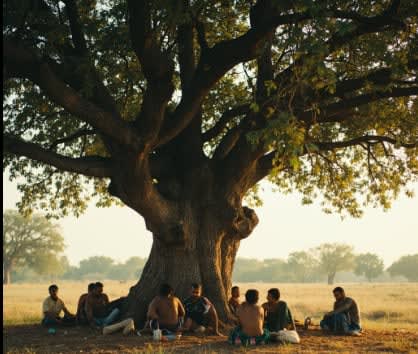
In nearly every traditional Indian village, there is a banyan tree. It is rarely just a tree. It is a landmark, a meeting place, a place of shelter, a site of worship, and the unwritten address of the community's collective memory. The village banyan tree is where life happens — slowly, peacefully, and with an unhurried depth that modern spaces rarely offer.
A Living Landmark
The banyan tree (Ficus benghalensis) is one of the most remarkable trees on the planet. Its aerial roots descend from branches and take hold in the earth, creating new trunks that can spread across hundreds of metres over centuries. The largest living banyan tree in India, at the Acharya Jagadish Chandra Bose Botanical Garden in Kolkata, covers more than 3.5 acres and is estimated to be over 250 years old.
A village banyan is rarely as large, but it carries the same quality of presence — an ancient, permanent living structure that predates the current generation of villagers and will likely outlive the next several ones too. Standing under a banyan is standing inside something that has been here a very long time.
The Social Role of the Banyan
Traditionally, the banyan tree has been the site of the village panchayat — the community council where disputes are resolved, decisions are made, and community matters are discussed. The shade it provides makes it a natural gathering place for elders who sit and talk through the hottest hours of the afternoon. Farmers rest under it after long mornings in the fields. Children play in its shadow and swing from its aerial roots.
In many villages, the banyan tree serves as the informal community centre — the place where news travels, where marriages are announced, where returning relatives from the city are welcomed back, and where losses are mourned together. It is the village's common room, open to everyone without charge or condition.
Spiritual Significance
The banyan tree holds deep spiritual significance in Hindu tradition. It is associated with Lord Vishnu and is considered immortal — capable of regenerating indefinitely through its roots. During Vat Savitri Puja, women wrap threads around the banyan trunk and pray for the long life of their husbands, circling the tree in a ritual that connects the living with the eternal.
Small shrines are often built at the base of village banyans. Offerings of flowers, incense, and oil lamps are placed there daily. The tree itself becomes a kind of deity — something that gives without asking, shelters without judging, and persists beyond any individual human life.
What the Banyan Represents
The banyan tree is a symbol of everything that makes village life distinct from urban life: rootedness, continuity, shade freely given, community without transaction, and the slow passage of time measured not in deadlines but in seasons. It is the social heart of the village precisely because it asks nothing of the people who gather beneath it — only that they come, sit, and belong.
In an age when community spaces are increasingly commercialised and communal life is harder to find, the village banyan tree stands as a reminder that the most valuable gathering places are often the oldest and most natural ones.
Frequently Asked Questions
What is Banyan Tree Gatherings?
The ancient banyan tree has been the social and spiritual heart of Indian villages for centuries — a gathering place for community decisions, storytelling, rest, and connection.
What makes Banyan Tree Gatherings special or unique?
The ancient banyan tree has been the social and spiritual heart of Indian villages for centuries — a gathering place for community decisions, storytelling, rest, and connection.
How can Banyan Tree Gatherings improve everyday life?
In nearly every traditional Indian village, there is a banyan tree. It is rarely just a tree. It is a landmark, a meeting place, a place of shelter, a site of worship, and the unwritten address of the community's collective memory.
Is Banyan Tree Gatherings relevant for people in rural and urban India?
Yes, Banyan Tree Gatherings is relevant across both rural and urban India. While the context may differ slightly, the core ideas and lessons apply to people from all walks of life throughout the country.
What do experts say about Banyan Tree Gatherings?
Experts generally agree that Banyan Tree Gatherings carries significant value and relevance. The article above draws on credible perspectives and real-world examples to give you a well-rounded understanding of the subject.
Version History 4 updates
- Jun 16, 2026
Updated: faqs
- Jun 4, 2026
Updated: description, content
- Apr 29, 2026
Updated: title, description, content, categories, tags, featuredImage, images, status, rejectionReason
- Apr 29, 2026
Updated: title, description, content, categories, tags, featuredImage, images, status, rejectionReason