
AI Won't Replace Everyone: Why Learning AI Matters in 2026
Will AI take your job? Learn how AI is changing the workplace, why AI skills matter more than ever, and practical ways to stay competitive in 2026.
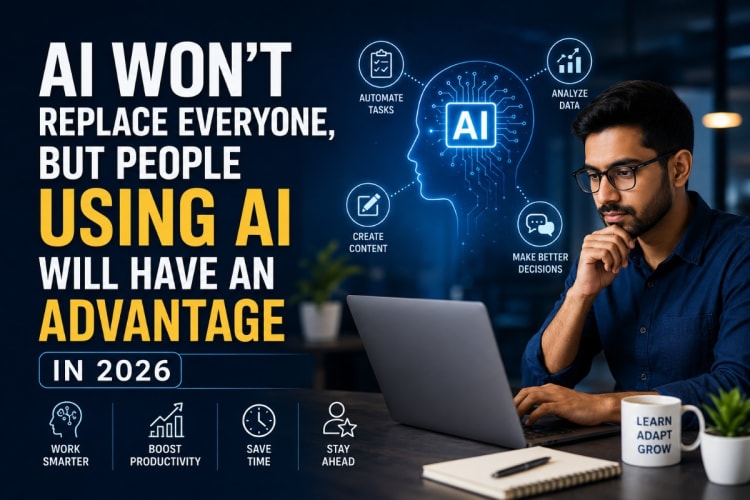
AI Won't Replace Everyone, But People Using AI Will Have an Advantage in 2026
Artificial Intelligence (AI) has become one of the biggest topics in technology, business, and education. Every day, new AI tools are launched that can write content, generate images, analyze data, create presentations, write code, and even answer complex questions within seconds.
This rapid growth has led many people to ask the same question:
"Will AI take my job?"
The answer isn't as simple as "yes" or "no".
AI is certainly changing the way we work. Some repetitive tasks are becoming automated, some jobs are evolving, and new careers are emerging. In many workplaces, employees who know how to use AI effectively are becoming more productive and valuable.
Instead of fearing AI, it's more useful to understand how it can become a skill that helps you grow in your career.
Let's explore what this means for professionals, students, freelancers, and businesses in 2026.
Why Everyone Is Talking About AI
A few years ago, AI felt like something only large technology companies used. Today, it's available to almost everyone.
Whether you're writing emails, designing graphics, analyzing spreadsheets, or preparing presentations, there's probably an AI tool that can help.
Businesses are adopting AI because it can:
- Save time
- Reduce repetitive work
- Improve productivity
- Help employees focus on higher-value tasks
- Speed up decision-making
This doesn't necessarily eliminate the need for people. Instead, it changes how people work.
AI Is Changing Jobs, Not Just Replacing Them
One of the biggest misconceptions is that AI simply replaces workers.
In reality, many jobs consist of multiple tasks. AI may automate some of those tasks while leaving others that require human judgment, creativity, communication, or relationship-building.
For example:
Marketing
AI can:
- Generate content ideas
- Draft social media posts
- Analyze campaign performance
Humans still:
- Build brand strategy
- Understand customer emotions
- Make creative decisions
Software Development
AI can:
- Suggest code
- Find bugs
- Generate boilerplate code
Developers still:
- Design software architecture
- Solve complex business problems
- Review and improve AI-generated code
Customer Support
AI chatbots can answer common questions, but human agents are still needed to handle complex issues, negotiate solutions, and build customer trust.
The pattern is clear: AI is taking over repetitive work, while people continue to contribute skills that machines cannot easily replicate.
Why AI Users Often Gain an Edge
Imagine two employees with similar experience.
Employee A completes reports manually. Employee B uses AI to draft reports, summarize meetings, organize research, and automate repetitive tasks.
If Employee B consistently delivers quality work faster, employers may view them as more efficient, not because AI replaced Employee A, but because AI became a productivity tool.
This is why AI skills are becoming increasingly valuable across many industries.
Skills AI Still Can't Fully Replace
Technology continues to improve, but several human strengths remain difficult to automate.
These include:
- Critical thinking
- Leadership
- Emotional intelligence
- Negotiation
- Creativity
- Strategic planning
- Ethical decision-making
- Relationship building
- Public speaking
- Team management
- Professionals who combine these abilities with AI tools are often well positioned for the future.
How Different Professionals Can Benefit from AI Students
Students can use AI to:
- Understand difficult concepts
- Summarize textbooks
- Practice interview questions
- Improve writing
- Create study plans
AI should support learning, not replace it.
Developers
Developers can use AI to:
- Generate sample code
- Debug programs
- Learn new frameworks
- Create documentation
- Explain complex algorithms
Content Creators
AI helps with:
- Brainstorming topics
- Writing outlines
- Editing grammar
- Generating image ideas
- Creating social media captions
Human creativity still makes the final content engaging and authentic.
Business Owners
Businesses can use AI to:
- Respond to customer inquiries
- Analyze sales data
- Generate reports
- Create marketing campaigns
- Improve productivity
AI Skills Worth Learning in 2026
You don't need to become an AI engineer to benefit from AI.
Consider building skills such as:
Writing effective prompts- Using AI for research
- AI-assisted writing
- AI presentation tools
- AI image generation
- Data analysis with AI
- AI-powered coding assistants
- Workflow automation
- AI-powered customer support
- These skills can be valuable across many professions.
Common Myths About AI
AI knows everything.
AI can make mistakes and provide outdated or inaccurate information. Human verification is still important.
AI will replace every job.
Some tasks may be automated, but many roles are changing rather than disappearing.
Only programmers need AI.
Professionals in marketing, finance, healthcare, education, design, HR, and many other fields are also using AI.
Learning AI is difficult.
Many AI tools are designed with simple, user-friendly interfaces that require little or no coding knowledge.
How to Stay Competitive in an AI-Driven Workplace
If you want to prepare for the future, focus on continuous learning.
A practical roadmap:
- Learn one AI tool relevant to your work.
- Practice writing better prompts.
- Improve your communication skills.
- Strengthen problem-solving abilities.
- Keep learning as AI evolves.
- Combine technical knowledge with human skills.
- Stay curious and adaptable.
- Small improvements made consistently can have a meaningful impact over time.
The Future Belongs to People Who Adapt
Every major technological shift has changed the way people work.
The internet changed business.
Smartphones changed communication.
Cloud computing changed software.
AI is changing productivity.
Rather than replacing every worker, AI is becoming another tool that many professionals can use to work more efficiently. Those who understand how to combine AI with their own expertise are likely to be well prepared for the changing workplace.
Frequently Asked Questions
Will AI replace all jobs?
No. AI is automating some tasks and changing many jobs, but human skills such as creativity, leadership, judgment, and communication remain important.
Which jobs benefit most from AI?
Software development, marketing, customer support, education, finance, design, sales, and business operations are among the fields where AI can significantly improve productivity.
Do I need coding skills to use AI?
No. Many AI tools are designed for everyday users and require no programming knowledge.
What is the most important AI skill to learn?
Learning how to use AI effectively for your specific work—such as writing better prompts, verifying outputs, and integrating AI into your workflow—is often more valuable than mastering a single tool.
Is AI a threat or an opportunity?
It can be both. AI may automate certain tasks, but it also creates new opportunities for people who learn to work alongside it and develop complementary human skills.